


Global infrastructure investment continues to shift eastward, with China’s Belt & Road Initiative (BRI) and similar programmes driving a wave of large, complex projects across Asia, the Middle East, Africa and Europe. Alongside the opportunity, dispute volumes are rising, and arbitration has become the primary forum for resolving them.
At a recent seminar on Infrastructure Arbitration: Belt & Road and Beyond held in London, practitioners and arbitrators shared their experience of how these disputes are evolving in practice. This article summarises the key themes for contractors and commercial teams delivering major international infrastructure projects.
1. Belt & Road Projects Are Driving a New Wave of Construction Arbitration
BRI–related schemes span land and maritime corridors across Central Asia, Europe and Africa. With that scale has come:
- A high proportion of construction and infrastructure disputes being referred to arbitration.
- Increased use of international commercial courts and arbitration centres in Singapore, London, Hong Kong, Dubai and China.
- A gradual shift in Chinese parties’ behaviour – from historically being respondents to now taking a more active role as claimants where necessary.
For contractors, this means that dispute resolution clauses are no longer just boilerplate. The choice of seat, institution and governing law will directly affect the cost, duration and predictability of any eventual arbitration.
2. Choosing the Right Seat: Neutrality, Judiciary and Culture
While London, Hong Kong and Singapore remain the main seats for Belt & Road disputes, parties are becoming more discerning about where they arbitrate.
Key trends:
- Singapore as a magnet: The quality of the judiciary and the availability of experienced, often retired, English and international judges has made Singapore particularly attractive as a neutral venue.
- Moving away from Hong Kong for some disputes: Security law changes have led some parties to prefer other neutral seats where the perceived atmosphere is less politically sensitive.
- Regional hubs emerging: In Africa, governments and regional bodies are increasingly encouraging arbitrations to be seated locally rather than automatically going to Europe.
Alongside legal considerations, cultural expectations matter. Parties may be more comfortable with a seat whose legal culture, language and procedure feel familiar – but that comfort must be balanced with neutrality, enforceability and perception of independence.
Practical steps for contractors
- Stress–test proposed seats for neutrality, judicial quality and enforceability in relevant jurisdictions.
- Discuss the choice of seat and institution early, not at the end of negotiations.
- Be clear on the trade–offs between “home” courts and truly neutral venues.
3. Dispute Boards and Med–Arb: Keeping Projects Moving in China
Chinese practice on infrastructure projects makes frequent use of structured dispute resolution mechanisms that aim to avoid work stopping while disputes are resolved.
Common tools include:
- Dispute Boards (DBs): Widely used over the last five years, particularly because of their cost and time efficiency. Boards may have a technical, financial or insurance focus depending on the project.
- DAB / DAAB / DRB models: Variants of dispute boards designed to give binding or non–binding decisions without interrupting progress to move straight into arbitration.
- “Med–Asian” models: Hybrid procedures that start with mediation and can convert into arbitration if settlement is not reached.
For international contractors working with Chinese partners, these mechanisms can feel unfamiliar but are central to contract strategy.
Contractor considerations:
- Clarify the powers, timelines and binding nature of any dispute board or Med–Arb mechanism.
- Ensure the dispute board process dovetails with statutory limitation periods and any arbitration rules.
- Train project teams on how to present issues to boards effectively; they are often the first forum where the dispute “story” is tested.
4. Sanctions, Security Laws and the Risk of Ineligible Arbitrators
Sanctions regimes are a growing source of complexity in infrastructure arbitration.
Points highlighted at the seminar included:
- Differences between jurisdictions: In the UK and Europe, sanctions are imposed for a range of political and human–rights reasons and can restrict who may act as arbitrator or counsel. In China, sanctions may be imposed directly on arbitration participants.
- Practical impact: Parties may need exemptions in the country of origin to proceed with arbitrations involving sanctioned states or entities.
- Negligence risk for counsel: Putting forward an arbitrator who is, or becomes, sanctioned without proper checks could create separate professional or procedural issues.
What contractors and in–house teams should do:
- Build sanctions checks into arbitrator selection and panel approval processes.
- Consider whether the proposed seat and institution are exposed to conflicting sanctions regimes.
- Document how sanctions risk has been considered when agreeing the dispute resolution clause.
Need support with risk management or contract administration?
We are currently helping contractors stay commercially protected while delivering complex projects. Speak to us about how we can help you on your project.
5. Middle East Disputes: FIDIC Dominance and Long Timelines
In the Middle East, the majority of large infrastructure and energy disputes continue to arise under FIDIC–based contracts – often the 1999 forms or even older editions.
Key observations included:
- FIDIC procedures vs statutory timelines: FIDIC’s notice and decision periods (e.g. 28 days for notice, 42 days for determinations and reviews) can be lengthy compared with UK statutory adjudication frameworks, leading to tension on cross–border projects.
- Legacy contract forms: Some employers still rely on outdated versions of FIDIC, or bespoke amendments that are poorly coordinated across the supply chain.
- Mediation alongside arbitration: Mediation is not always culturally embedded, but where used, it often runs in parallel with arbitration rather than as a true alternative.
For contractors delivering Middle East work, the message is clear: understand precisely which edition and amendments apply, and how they interact with local law and any compulsory dispute steps.
6. Belt & Road Corridor Challenges: Logistics, Infrastructure and Inequality
The session also explored the wider “middle corridor” of the Belt & Road, running through Central Asia and neighbouring regions.
Challenges highlighted included:
- Ageing or inadequate infrastructure in certain states.
- Logistical bottlenecks caused by poor coordination between land and sea routes.
- Unequal development and unequal access to arbitration and dispute resolution resources between countries.
These structural issues inevitably translate into delay, disruption and cost escalation risks on projects that cross multiple jurisdictions.
Implications for contractors:
- Map logistics and infrastructure dependencies explicitly in risk registers and programme assumptions.
- Ensure that interface risks between different states or modes of transport are allocated clearly in the contract.
- Consider whether a single dispute forum is realistic, or whether multi–tiered or multi–contract approaches are needed.
7. Process Design, Culture and the Human Side of Arbitration
the panel and Q&A emphasised the importance of process design and cultural awareness:
- Neutral evaluation and mediation: Neutral evaluation can provide an early steer on likely outcomes and is highly valued where neutrals are experienced and culturally attuned. However, its use in large Belt & Road projects remains limited.
- Cultural fit: The success of mediation or settlement–focused processes depends heavily on the cultural expectations of the parties and the style of the mediator.
- Expectations of arbitrators: Parties increasingly expect arbitration panels to be sensitive to the commercial realities of projects, manage time effectively and acknowledge when they cannot take on further work.
For contractors and their advisors, this reinforces the importance of choosing neutrals who understand both the technical and cultural context of the dispute.
Infrastructure Arbitration on the Belt & Road for Contractors: Key Takeaways
Practical Takeaways for Contractors
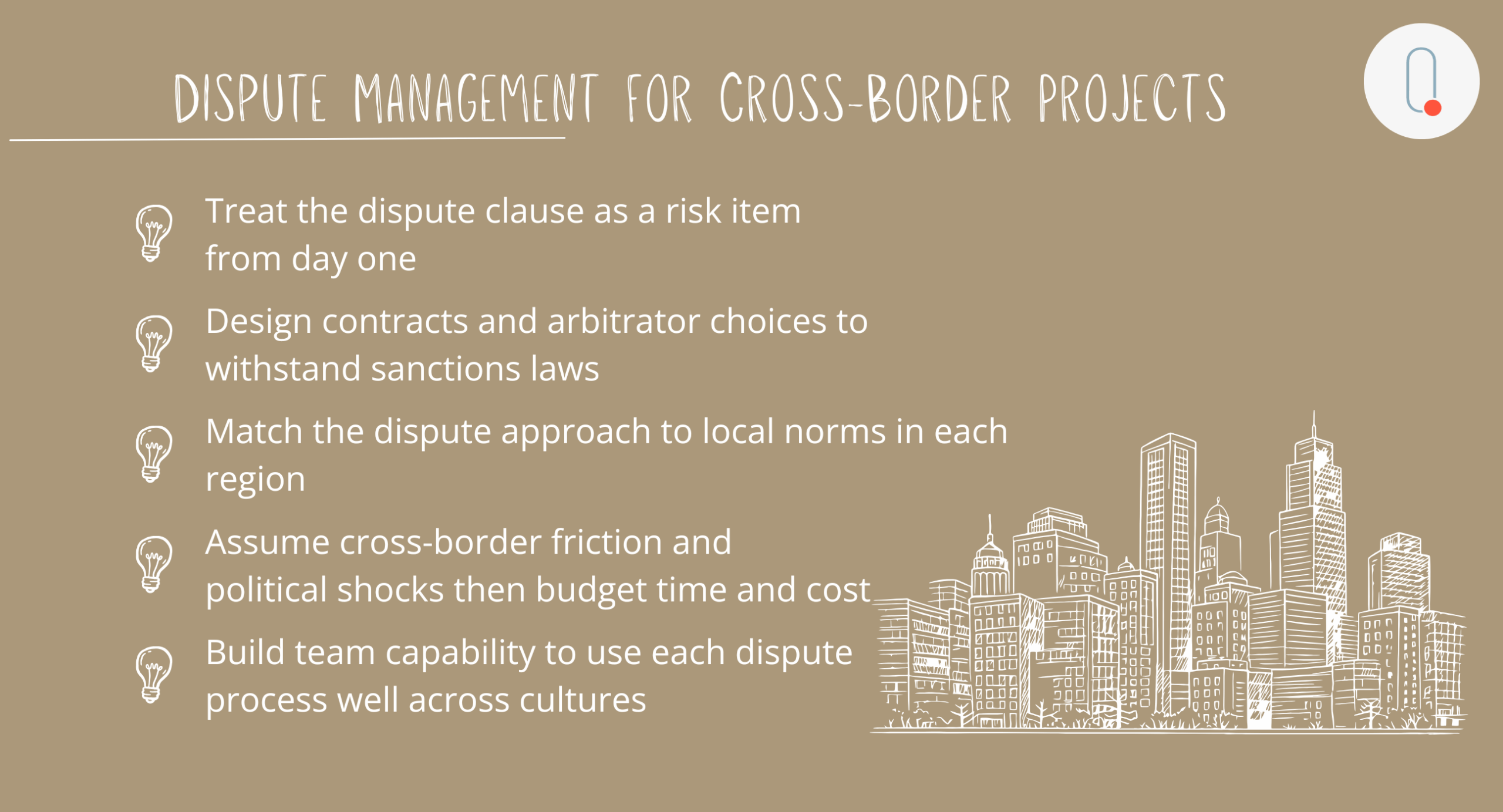
When bidding for or delivering major international infrastructure projects linked to the Belt & Road or similar initiatives, contractors should:
- Interrogate the dispute resolution clause early – seat, institution, governing law and any dispute board or Med–Arb mechanisms should be tested for neutrality, practicality and enforceability.
- Address sanctions and security law risks explicitly in arbitrator selection and contract drafting.
- Understand local practice in key regions – particularly FIDIC usage in the Middle East and the prevalence of dispute boards and hybrid processes in China.
- Plan for cross–border logistics and political risk, building realistic time and cost contingencies into programmes.
- Invest in cultural and procedural awareness within project and in–house teams so that mediation, neutral evaluation and arbitration can be used effectively.
If you are currently negotiating or delivering an international infrastructure project and would like support reviewing your dispute resolution clauses, risk allocation or claims strategy, Quantum Project Control can help.
We work with contractors across the UK, Europe, the Middle East and Asia to manage commercial risk, avoid disputes where possible and position projects effectively when arbitration becomes unavoidable.
Disclaimer
Quantum Project Control is not a law firm and does not provide legal advice. This article is for general information purposes only and should not be relied upon as legal advice. For guidance on specific issues, please consult a qualified legal professional.

 EN
EN UK (English)
 DK (Danish)