


Major energy projects — particularly offshore interconnectors, subsea cables, and grid infrastructure — continue to grow in scale and complexity. With that growth has come a rise in disputes, many of which stem not from dramatic technical failures, but from very ordinary issues: unclear scopes, delayed mobilisation, unclear purchase orders, and incomplete records.
A recent seminar during London Arbitration Week, drawing heavily on insights from the Viking Link project, provided a candid look at how and why disputes arise on energy schemes and what contractors can do differently to protect themselves.
Below, we summarise the themes most relevant to contractors, commercial teams and project managers working across the energy sector.
1. Early–Stage Risks: Logistics, Customs and Mobilisation Failures
Some of the most costly disputes arise before construction even begins. Common early–stage issues discussed included:
- Vehicles delivered late, with incorrect configuration, or held up in customs.
- Slopes, access routes or foundations prepared incorrectly before installation.
- Contractors missing mobilisation dates or arriving with the wrong competence mix.
- Clients wanting to pay less due to delay; contractors wanting more due to scope changes.
These risks tend to create an immediate tension between parties and increase the likelihood of claims.
Contractor actions
- Treat logistics as a core risk – not merely an operational detail.
- Ensure customs documentation, transport plans and access arrangements are checked independently.
- Build contingency into mobilisation plans and communicate early warning signals clearly.
2. Contract & Scope Precision: The Foundation of Every Dispute
The seminar emphasised one message repeatedly: if you get the scope wrong, nothing in your terms and conditions will save you later.
Examples shared included:
- Multiple purchase orders issued for the same work with unclear progression of requirements.
- Revised POs being issued to correct earlier ambiguity – a symptom of unclear contracting.
- A contractor claiming the PO had been verbally amended; the judge rejected the argument due to lack of evidence.
A weak or vague scope is one of the strongest predictors of future disputes.
Key points for contractors
- Invest time at the front end to ensure every requirement is explicit.
- Challenge unclear employer specifications and assumptions before signing.
- Avoid reliance on verbal agreements or informal understandings.
- Ensure the contract reflects how the project will actually be delivered.
3. Insurance Markets Tightening: Drafting Matters More Than Ever
Movement in the professional indemnity (PI) insurance market means insurers are looking closely at how contracts allocate risk.
Implications include:
- Poorly drafted scopes increase perceived exposure, affecting premiums and coverage decisions.
- Contractors cannot rely on insurance as a replacement for proper risk management.
- Insurers must be involved early when issues arise, or they may resist cover later.
Contractor actions
- Treat insurance as the last safety net, not the first line of defence.
- Engage insurers early and present a coherent narrative of emerging issues.
- Ensure contract drafting and risk allocation align with insurability.
4. Operational Stage: Records Win (or Lose) the Dispute
Across energy and offshore projects, the factual record decides most disputes.
The panel reinforced several operational realities:
- Offshore works typically require daily or even hourly records.
- Whoever writes the daily record “writes the history.”
- Photographic evidence is crucial – “Pics or it didn’t happen.”
- It does not matter what actually happened; it matters what you can prove.
Poor record keeping is one of the fastest routes to losing a case at arbitration.
Contractor actions
- Train site teams on effective record–keeping and the importance of contemporaneous evidence.
- Ensure all site diaries, progress photos, meeting notes and communications are stored centrally.
- Standardise record formats across subcontractors to avoid gaps.
Need support with risk management or contract administration?
We are currently helping contractors stay commercially protected while delivering complex projects. Speak to us about how we can help you on your project.
5. Dispute Resolution: Experts, Witnesses and Case Discipline
Technical disputes in the energy sector often hinge on expert evidence. The seminar highlighted several lessons:
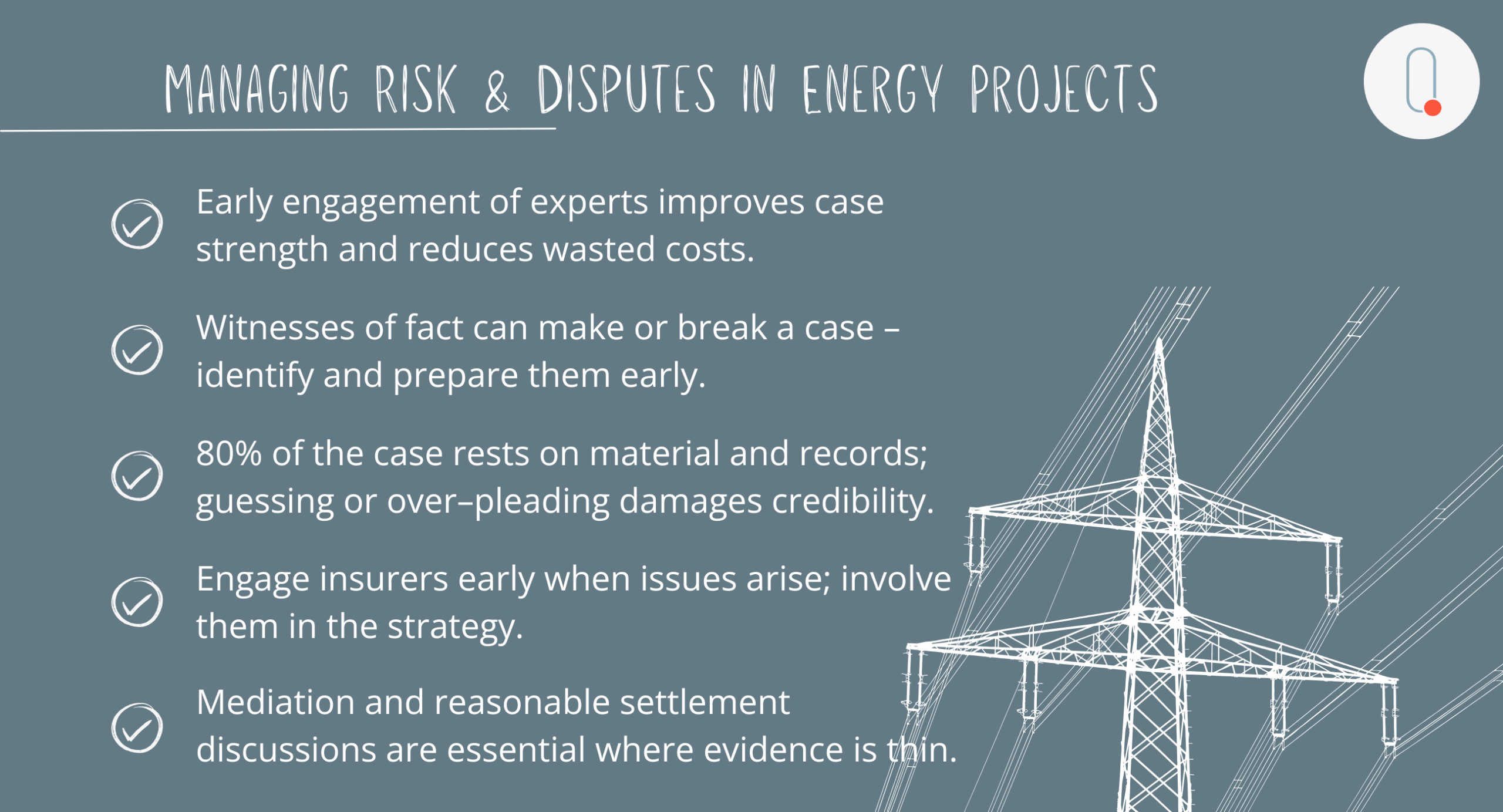
Early engagement of experts is critical
- It can be difficult to justify the cost early, but waiting too long weakens the case.
- Early experts shape the narrative and prevent wasted points being pleaded.
- A technical expert in the tribunal accelerates proceedings and reduces cost.
Witnesses of fact can make or break a case
- Identify who your witnesses are early – and keep them on the project if possible.
- Have witnesses prepare statements while memories are fresh.
- Dismissing a witness may unintentionally damage your case.
Case discipline matters
- 80% of the case rests on documents, not arguments.
- “If you don’t know – don’t guess.”
- Avoid running weak or speculative points; doing so wastes time, money and credibility.
Settlement options
- Where evidence is thin, mediation or commercial settlement may be the most rational path.
- The stronger your records, the stronger your leverage in any settlement discussion.
6. Customs, Correspondence and the Risk of Missteps
One particularly practical warning concerned correspondence with authorities:
- Never send inaccurate statements to customs or regulators.
- Assume every line of correspondence could be read aloud in a tribunal.
- Misrepresentation, even accidental, can undermine your entire case.
This reinforces the need for disciplined communication and clear internal approvals before anything is issued externally.
Getting the Basics Right Wins Disputes
Energy disputes are often portrayed as battles over major technical failures. In reality, many arise from – and are won or lost on – much more fundamental issues:
- Clarity of scope
- Quality of drafting
- Discipline in record–keeping
- Early expert involvement
- Credibility of witnesses
- Consistent communication and documentation
Contractors who invest early in these fundamentals put themselves in the strongest possible position if disputes arise later – and can often avoid arbitration entirely.
If you are currently bidding for, delivering or closing out an energy project and would like support with contract review, risk strategy or dispute positioning, Quantum Project Control can help.
Disclaimer
Quantum Project Control is not a law firm and does not provide legal advice. This article is for general information purposes only and should not be relied upon as legal advice. For guidance on specific issues, please consult a qualified legal professional.

 EN
EN UK (English)
 DK (Danish)